
Institut de Biologia Evolutiva - CSIC UPF
"Pavlov’s dog” is now an amoeba: researchers show individual cells can be trained
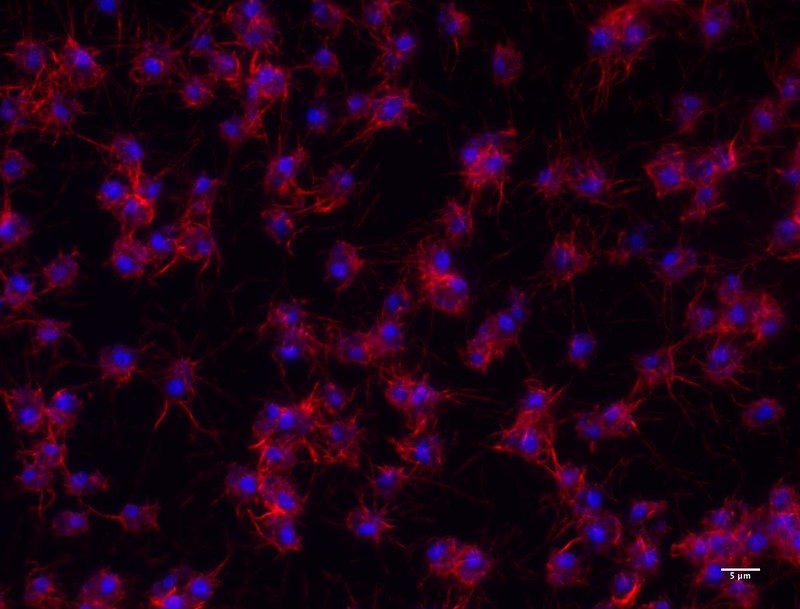
Often regarded as simple microorganisms, lacking a defined shape or will of their own, amoebae are commonly portrayed in the popular imagination as an almost accidental form of life. However, their ability to adapt to their environment is exceptional, leading the scientific community to ask: do these unicellular organisms truly depend only on genetic evolution, or can they learn and remember throughout their lifetime?
A groundbreaking study by the Institute of Evolutionary Biology (IBE), a joint center of the Spanish National Research Council (CSIC) and Pompeu Fabra University, has demonstrated for the first time that the amoeba Capsaspora owczarzaki can be trained to remember and anticipate thermal shock. The work combines a mathematical framework with experimental validation to successfully replicate Pavlov’s principle in a unicellular organism.
The results provide evidence that associative learning predates brains and neurons, with important implications for the origins of memory, learning capacity, and the evolution of animals from their unicellular relatives.
The first associative learning in amoebae
Traditional evolutionary models assume that adaptation to dramatic environmental shocks is a blind process: genetic mutations arise randomly, and natural selection favors survivors over countless generations. However, cellular resistance often appears much earlier.
To explain this paradox, the study tested the learning capacity of a unicellular organism. The IBE team developed a custom-built robotic device called the Smart Incubator to subject Capsaspora owczarzaki cells to Pavlovian classical conditioning training. One group of cells was exposed to a predictable environment: an LED light signal, together with mechanical vibration, consistently preceded moderate heat stress at 32°C. A second control group experienced exactly the same amount of light, vibration, and heat, but with a completely random timing relationship. At the same time, the team used Bayesian mathematical models to predict under which conditions learning would be advantageous for the cells.
After 35 training cycles, a final lethal thermal shock of 38°C was applied. Cells that had lived in the predictable environment showed a mortality rate of only 12.1%, compared with 26.8% in the control group. Overall, trained cells reduced mortality by 55%, demonstrating the success of the conditioning.
“When we think about learning, we almost automatically think of brains, neurons, and animal intelligence. However, the training of Capsaspora shows that these cells are capable of inferring their environment, learning, and protecting themselves,” explains Maor Knafo, postdoctoral researcher at IBE and first author of the study.
However, the molecular mechanism acting as a “memory storage system” in the absence of neurons remains under investigation. Furthermore, learning carries a metabolic cost that is not always beneficial: when environmental unpredictability exceeded 20%, cells stopped preparing for thermal shock.
Breaking the limits of classical evolution
The amoeba Capsaspora owczarzaki is one of the closest living unicellular relatives of animals, making it a key evolutionary bridge for understanding how learning capacities may have paved the way toward multicellularity.
“Studies on the origin of animals have repeatedly shown us that many features we once believed to be exclusively animal—such as cell adhesion or signaling—have much deeper evolutionary roots. Information processing and associative capacity are no exception. Perhaps the first fundamental step toward complex multicellular life was not only that cells learned to cooperate with one another, but also their individual and collective ability to learn from their environment and interpret their own world,” says Elena Casacuberta, principal investigator at IBE and co-author of the study.
The study provides evidence of adaptive cellular memory within a single generation.
“These results expand the established understanding of learning and memory in animals toward their unicellular ancestors. We will need to continue recognizing patterns of learning and adapting what we know about them,” says Iñaki Ruiz-Trillo, principal investigator at IBE and co-author of the study.
The study also opens the door to a paradigm shift in future synthetic biology research. Instead of designing rigid genetic circuits, cells could be programmed and trained to learn and respond autonomously based on their own survival outcomes. This emerging line of research suggests a new way of designing and using living systems, with potential future medical applications.
Referenced article:
Beyond Diffusion: Bayesian Learning Strategies in Single-Cell Life. Maor Knafo, Elena Casacuberta, Iñaki Ruiz-Trillo. PRX Life, 2026. 4, 023025. DOI: 10.1103/5p5z-t8qy