
Institut de Biologia Evolutiva - CSIC UPF
The immune system preserves a genetic program older than animals themselves
The transition from unicellular life to multicellular organisms posed a fundamental challenge for early animals: how to defend a body made up of multiple cells, coordinate resource transport, and protect themselves from pathogens.
An international team of researchers, led by Kyoto University (Japan) and the Institute of Evolutionary Biology (IBE, CSIC-UPF), a joint center of the Spanish National Research Council (CSIC) and Pompeu Fabra University (UPF), provides evidence that the solution was not the sudden appearance of new genes, but rather the reuse of an ancestral genetic program governed by the Fos gene.
The work, published in the prestigious journal PNAS, provides the first complete phylogenetic tree of blood cell lineages and reveals that the defenses of modern animals are strongly linked to their pre-metazoan origins.
The first blood cells resembled modern macrophages
To identify what the first animal blood cells looked like, the team went back roughly 700 million years in evolutionary history by comparing which genes were active in different cell types across highly distant species. To do this, they used an advanced computational method capable of analyzing transcriptomic data, that is, the full set of genes expressed by a cell.
The analysis included mammals such as humans and mice, vertebrates such as zebrafish, invertebrates such as tunicates, sea urchins, fruit flies, nematodes, and sponges, as well as unicellular organisms closely related to animals, such as Capsaspora owczarzaki and Salpingoeca rosetta.
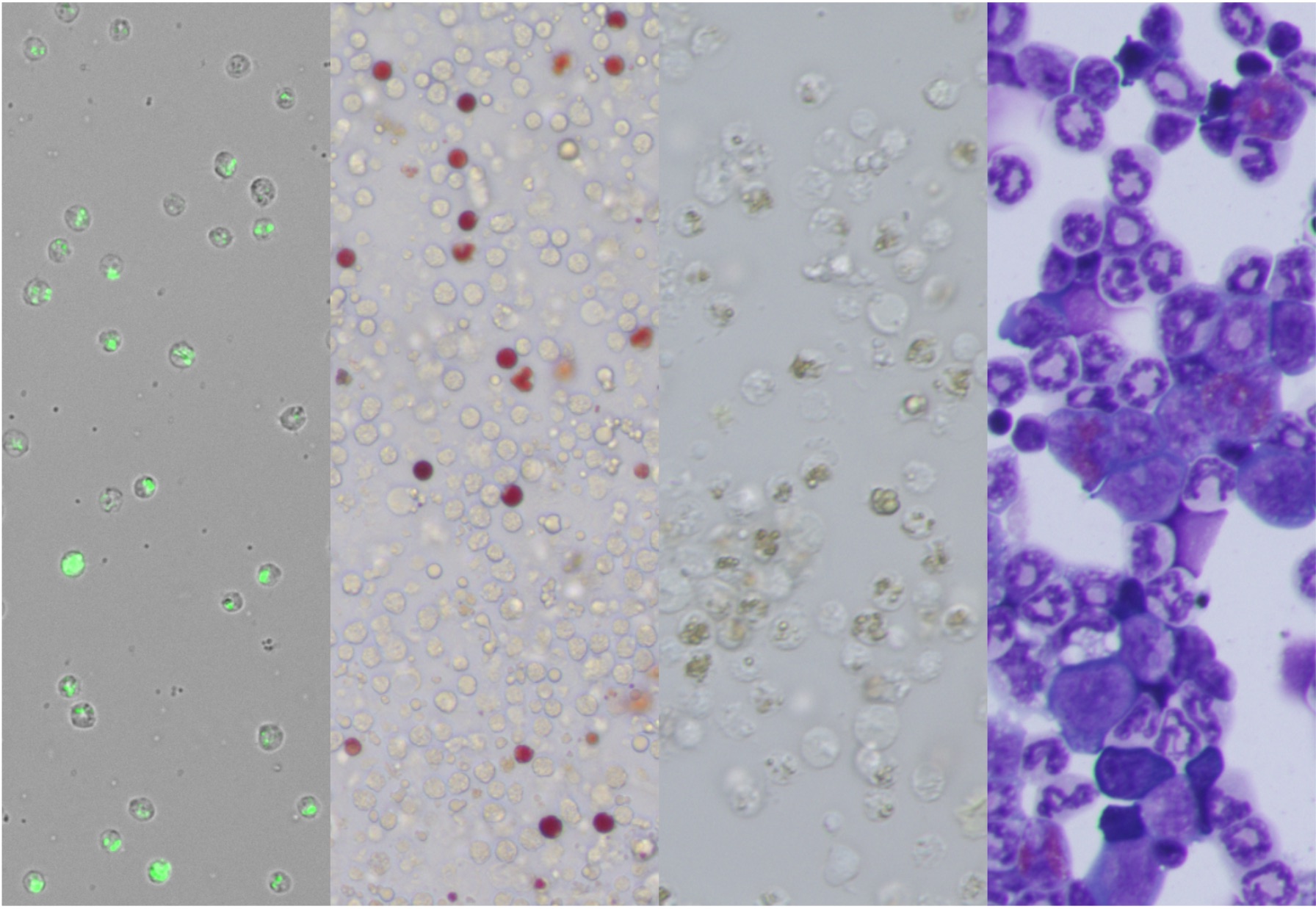
The results indicate that the earliest blood cells in Earth’s history had characteristics similar to modern macrophages: mobile cells responsible for patrolling, engulfing, and destroying pathogens.
These cells were likely regulated by the Fos gene, a key element in preserving this ancestral protective program. Its presence in unicellular organisms suggests that it already played this regulatory role long before animals emerged, and was later repurposed to regulate the first macrophages.
“We often think of our immune system as a recent innovation of vertebrates, but this study reminds us that our blood carries a much older genetic heritage. Some of the instructions our body uses today to fight infection already existed in the oceans before the first animals appeared,” explains Elena Casacuberta, principal investigator at IBE and contributor to the study.
The evolutionary journey of blood
The research suggests that after the appearance of these primordial macrophages at the origin of the animal lineage, a major evolutionary branching occurred in bilaterians (organisms with left-right symmetry). The presence of parasites may have favored the emergence of a more specialized lineage of defensive cells than macrophages: precursors of mast cells, equipped with cytotoxic granules to combat these infections.
In vertebrate ancestors, this cellular lineage branched further, giving rise to different cell types of today’s immune and blood systems, including T cells, NK (natural killer) cells, and erythrocytes. Meanwhile, B cells, which produce antibodies, appear to have arisen directly from the evolutionary branch associated with macrophages.
“Our data suggest that nature’s most important biological innovations do not necessarily arise from entirely new components,” explains Yosuke Nagahata, IBE researcher and first author of the study. “They emerge when ancient cellular programs are reorganized and regulated in new ways, even though those programs existed long before the first animal appeared.”

Emergence and divergence of blood cells. The origin of blood cells is traced back approximately 700 million years to when human ancestors were single-celled organisms. When these ancestors evolved into multicellular organisms (animals), macrophages emerged as the first blood cells. Over the course of subsequent evolution, various blood cells, such as mast cells, diversified. Credit: Yosuke Nagahata.
The team also highlights a significant finding in immune system organization: the possible emergence of a primitive thymus in regions associated with the gills of a chordate ancestor. Since gills are the main contact zone with the external environment and a gateway for viruses and bacteria, concentrating destructive immune cells in this region provided a major defensive advantage.
Development mirrors the evolutionary history of blood
One of the most surprising conclusions of the study is that the current process by which an organism generates blood cells (hematopoiesis) retains a direct trace of this evolutionary history.
In experimental mouse models, researchers observed that older cellular populations, such as macrophages and mast cells, retain greater differentiation potential than more specialized lymphocytes such as T and B cells. This process of cellular differentiation during development may reflect the order in which these cell types emerged throughout evolution.
The team notes that transcriptomic analysis cannot precisely determine when the key receptors of modern adaptive immunity emerged. In addition, regulatory networks in non-model species will require experimental validation, and expanding the study may provide new clues about the origin of multicellular life.
This study opens a window into the evolution of multicellular life, revealing how animal cells were reorganized 700 million years ago.
The study was primarily funded by the Japan Society for the Promotion of Science (JSPS), Spain’s Ministry of Science and Innovation (MICIU), and European FEDER funds. The authors declare no conflicts of interest.
Referenced article:
Y. Nagahata, Y. Nishimura, R. Kaitani, J.C.K. Leong, I. Oda-Ishii, H. Kohtsuka, S. Abe, T. Ishida, M. Carmona-Rivas S.R. Najle, E. Casacuberta, K. Ikuta, T. Miura, M. Ogasawara, N. Irie, Y. Satou, I. Ruiz-Trillo, & H. Kawamoto, Animals have expanded the evolutionary legacy of unicellular ancestors in blood cells, Proc. Natl. Acad. Sci. U.S.A. 123 (23) e2528110123, https://doi.org/10.1073/pnas.2528110123 (2026).