
Institut de Biologia Evolutiva - CSIC UPF
An amoeba discovered in Blanes reveals an unknown lineage and new behaviors
Amoebozoans are eukaryotic microorganisms that occupy a wide diversity of ecological niches. Some are pathogenic and are of particular relevance to medicine. They also occupy a special place in the tree of life, as a sister group to animals and fungi, which makes their study key to understanding the early evolution of both groups.
Now, a team from the Institute of Evolutionary Biology (IBE), a joint centre of the Spanish National Research Council (CSIC) and the Pompeu Fabra University (UPF), has discovered a new amoeba in Blanes: Apostamoeba explorator. It belongs to an unknown cellular lineage and displays a unique “double amoeba” behavior that allows it to mobilize two independent poles without ever dividing. The research provides the genomics of A. explorator and analyses the evolution of protein function in amoebozoans, animals and fungi. The results shed light on the evolution of all three groups, with potential implications for health and ecology.
Apostamoeba explorator displays an exceptional “double amoeba” behavior
Amoebae are unicellular microorganisms that maintain a dynamically stable shape, can have more than one cell nucleus and move by forming “false feet”, or pseudopods, by extending their cell membrane. Humans have amoeboid cells, such as macrophages, and some cancer cells behave in a very similar way. Together with their presence in a wide variety of ecological niches, this makes their study particularly relevant.
This study presents a new species of amoeba: Apostamoeba explorator, named after its tendency to explore its surroundings. The IBE team discovered it in a seawater sample from the beach of Blanes and managed to isolate it and grow it in the laboratory.
Using optical and electron microscopy, they observed a behavior that is unique among eukaryotes. They have described it as the formation of a “double amoeba”: a multinucleated cell becomes bipolarized into two poles that act semi-independently and eventually become reabsorbed into the same cell, without ever dividing.

“Double amoeba” behavior: Apostamoeba explorator becomes bipolarized and forms two poles with semi-independent behavior. DIC microscopy image. Scale bar: 10 μm. Credit: Gàlvez-Morante, A., Berney, C. & Richter, D. J., The evolution of gene functional repertoire in Amorphea: Divergent strategies across Amoebozoa, Fungi, and Metazoa, bioRxiv (2025). CC BY 4.0.
“Bipolarization is only observed during division in eukaryotic cells, a key point in many studies on cancer processes. It has similarities with cytoplasmic bridges between animal cells and could provide a useful comparison for studying them,” says Àlex Gàlvez-Morante, first author of the study and a predoctoral researcher at the IBE during the research. This behavior can be induced in the laboratory by reducing the amount of nutrients in the culture, which reinforces the theory that it has an exploratory function.
Characterizing a new cellular lineage
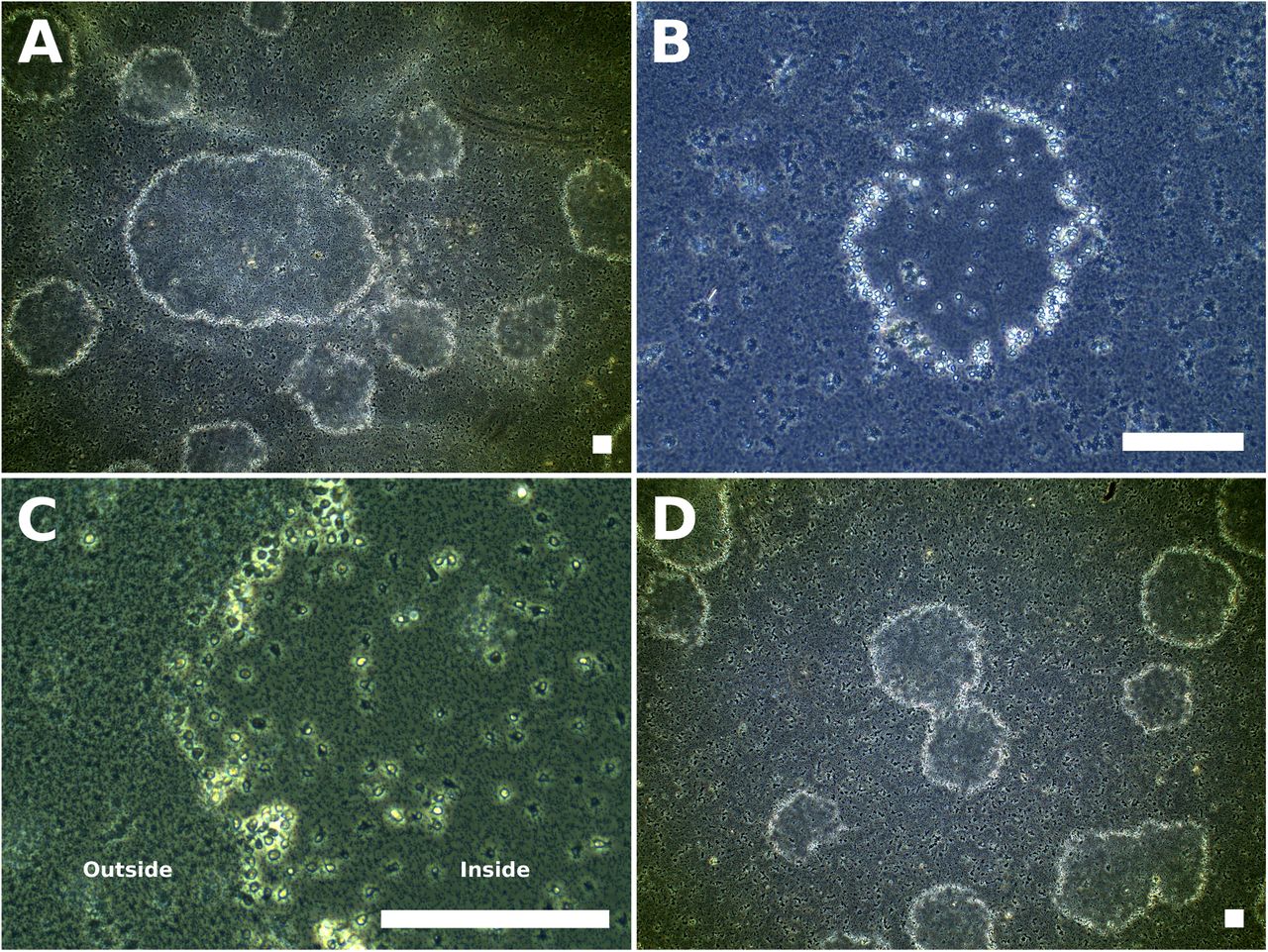
Beyond its individual movement, A. explorator is also able to communicate from cell to cell by extending subpseudopodia and forming “feeding fronts”: several ring-shaped amoebae move together over a bacterial biofilm. Given the low bacterial density measured inside the structure, the team confirms that the cells feed in a coordinated manner, acting like a “mower”. These rings can merge with one another to form larger structures that can reach more than 1.5 mm in size — one thousand times larger than the individual cells, which measure 5 µm.
DNA analyses reveal that A. explorator does not belong to any known amoeba lineage. Instead, it represents a new lineage at the order level that had remained hidden in environmental samples. In phylogenetic terms, this would be equivalent to discovering the order of primates or cetaceans among mammals.
“This new lineage is so distant from the rest of the amoebozoans that it leads us to hypothesize about the existence of numerous amoeba species that remain unknown to us,” concludes Daniel Richter, principal investigator of the IBE’s Laboratory of Biology and Ecology of Abundant Protists, who led the study. His group searches for the most abundant protists on the planet in order to characterize the biodiversity of these largely unknown organisms, providing new insights into the evolution of eukaryotes.
Genomic analysis of amoebozoans sheds light on evolution
Apostamoeba explorator belongs to the amoebozoans, a sister group to the lineage that gave rise to animals and fungi, and one that may hold clues to the origin of many eukaryotic species. To shed light on its evolution, the IBE team analysed its genetic content and compared it with that of fungi (Fungi) and animals (Metazoa). By grouping the proteins of the three groups according to their function, the researchers confirmed different evolutionary strategies.

The team from the IBE’s Laboratory of Biology and Ecology of Abundant Protists collects protists in the waters off the island of Grenada, in the Caribbean. From left to right: Daryna Zavadska, Cristiana Sigona, Adrià Auladell, Margarita Skamnelou and Daniel Richter. Seated in front: Àlex Gàlvez.
As observed in previous studies, metazoans have specialized in genes related to multicellularity, while fungi have specialized in metabolism and transport functions, which are essential for exploiting nutrients in their environment. Amoebozoans, however, followed a third independent evolutionary trajectory: they retained groups of genes associated with motility, phagocytosis and environmental adaptability — functions that are much closer to the ancestral state of the three groups: Amorphea.
“This ancestor was probably not specialized, but rather continuously adapted to changing environments,” explains Gàlvez-Morante. “The evolution of amoebae can teach us a great deal about the past of eukaryotes. The behaviour of A. explorator, however, offers a glimpse into the future of research. We will have to keep exploring,” concludes Richter.
Referenced article:
Alex Gàlvez-Morante, Cédric Berney, Daniel J. Richter, The evolution of gene functional repertoire in Amorphea: divergent strategies across Amoebozoa, Fungi, and Metazoa, Molecular Biology and Evolution, Volume 43, Issue 5, May 2026, msag071, https://doi.org/10.1093/molbev/msag07