
Institut de Biologia Evolutiva - CSIC UPF
The IBE hosts the Second Conference on Inclusion of the Escolab program
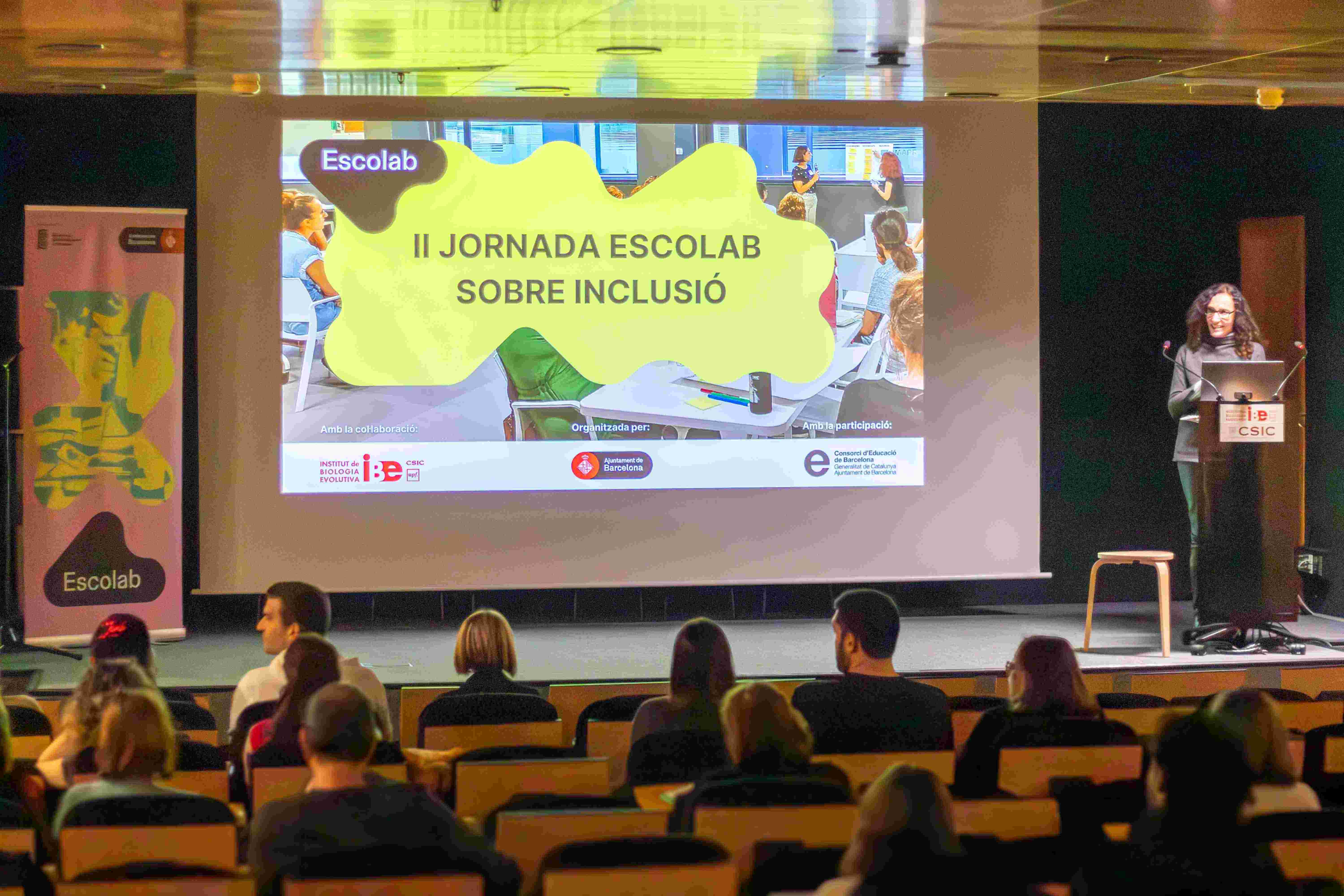
Last February 25, the Institute of Evolutionary Biology (IBE: CSIC-UPF) hosted the second Information and awareness day on inclusion within the framework of the Escolab program.
The event was organized in collaboration with the Inclusive Education Facilitators of the Barcelona Education Consortium (CEB) Mònica Català and Cristina Cegarra, and with the participation of Prudens Martínez, mentor in Universal Design for Learning (UDL) and head of the guidance department at INS Antoni Cumella in Granollers.
The day was mainly aimed at members of the research and science communication teams involved in the design and organization of Escolab activities who were interested in giving a more inclusive approach to their outreach activities.
During the sessions, participants had the opportunity to discover current research in this field, work on inclusion from a universal and practical point of view, based on two case studies, and resolve doubts with experts in the field of inclusive education.
One of the activities analyzed by the CEB was " Treescape: Discover the Secrets of Nature”, promoted by the IBE. The team highlighted that the activity offers an inclusive and accessible learning experience through gamification. Furthermore, the workshop facilitators employ diverse strategies and resources to adapt to the different learning styles of the students.
What is Universal Design for Learning (UDL)?
Based on decades of neuroscience research, Universal Design for Learning (UDL) is an educational framework that promotes inclusive education, as outlined in Decree 150/2017 of October 17. Its objective is to eliminate learning barriers and foster motivated, autonomous, and expert students in an accessible and equitable environment.
It is considered the best practice for teaching all students in an inclusive learning environment, as recognized in the United Nations Sustainable Development Goals (SDGs). Valuing diversity, it proposes offering multiple options so that all students can participate, learn, and express themselves, adapting to different styles and needs.
With technology as a key tool to design flexible and accessible materials, it applies to all elements of the curriculum and guides teachers towards a more personalized, transformative and equitable education, aimed at everyone.
Escolab program
The main objective of the Escolab program is to bring educational centers closer to the most cutting-edge laboratories, institutes and research centers through a set of free activities aimed at secondary school, high school and professional training students.
The program involves some seventy research laboratories belonging to research centers, universities, and R&D companies, offering around 250 different scientific activities - with a total of 500 sessions. Approximately 180 educational centers attend these activities.
Access the Escolab guide for creating activities on scientific topics for students: https://www.barcelona.cat/escolab/sites/default/files/2025-06/GuiaRecomanacions-Escolab_0.pdf
More information about the conference: https://www.barcelona.cat/escolab/ca/noticies/segona-jornada-sobre-inclusio-en-el-marc-descolab-1476710