
Institut de Biologia Evolutiva - CSIC UPF
Threatened Clouded Apollo butterfly conceals two species distinguishable by scent
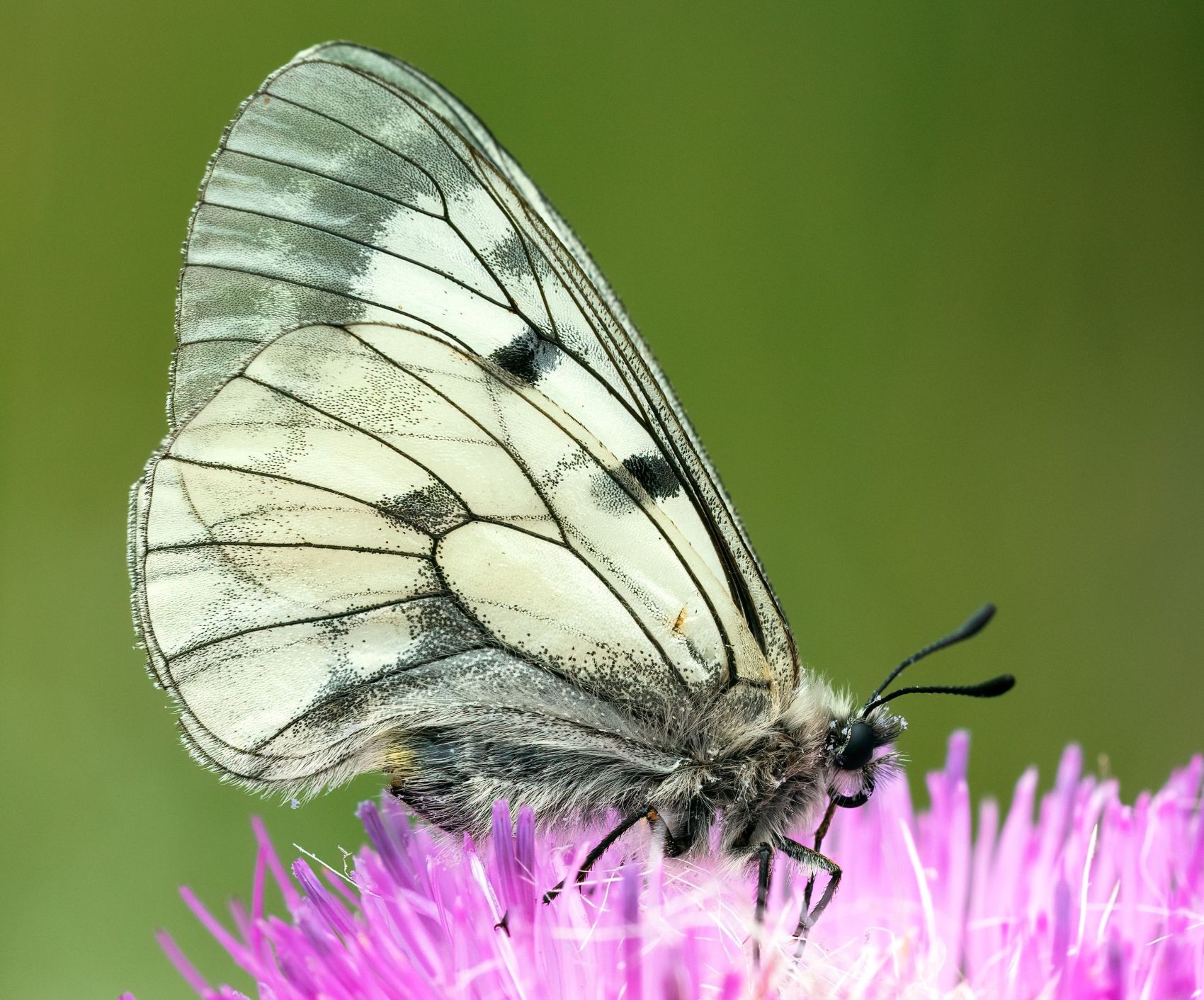
The butterfly Parnassius mnemosyne takes its name from Mnemosyne, the Greek goddess of memory. True to its namesake, this group of butterflies carries in its DNA a record of hundreds of thousands of years of evolution and survival in Europe. Yet that memory may be fading: populations are declining across Europe, and in the Catalan Pyrenees they have fallen by 95% over the past two decades, largely because of climate change. Despite being legally protected in Europe, the butterfly may be even more threatened than previously thought.
Now, research by the Institute of Evolutionary Biology (IBE), a joint centre of the Spanish National Research Council (CSIC) and Pompeu Fabra University (UPF), reveals that the Clouded Apollo actually comprises two cryptic species: Parnassius mnemosyne and Parnassius turatii. By combining genomic, chemical and morphological data with ecological and demographic modelling, the team reconstructed an evolutionary history shaped by glacial cycles and a “second chance” at speciation that is now evident in the Eastern Alps. The findings provide new insights into species evolution and could help protect these vulnerable pollinators.
Hundreds of thousands of years of evolution could disappear within decades
Genomic analyses revealed that the Clouded Apollo actually comprises two species: Parnassius mnemosyne and Parnassius turatii. Genomic markers reveal a pronounced genetic boundary in the Eastern Alps, where the two species share the same habitat.
The two lineages are thought to have diverged approximately 800,000 years ago. During the last glacial period—between roughly 115,000 and 12,000 years ago—these cold-adapted butterflies expanded across Europe and came back into contact in areas such as the Atlantic coast. At that time, they had not yet become separate species and interbred. When the warmer period began, both lineages retreated to their mountain refuges and diverged again as a result of isolation.

Clouded Apollo butterfly. Credit: Roger Vila.
Nevertheless, Pyrenean Clouded Apollo populations still retain the genomic signature of that ancient interbreeding. Today, however, no hybridisation has been detected between the two species where they coexist in the same habitat.
A “second chance” at speciation driven by male scent
Although the two lineages share the same ecosystem in their present-day contact zone in the Eastern Alps, the team detected no gene flow between the species.
“Because they are so similar in appearance and ecology, we turned to chemical analyses to look for differences that we might have been overlooking,” says Roger Vila, principal investigator of the Butterfly Diversity and Evolution Lab at the IBE.
The analyses revealed that, in contact zones, males have distinct chemical profiles that give them different scents. These signals may help females recognise males of their own species and avoid mating between lineages.
“Scent plays an important role in butterfly mating, but this is the first documented case in which two species show bidirectional chemical displacement: scent differences become more pronounced in both species at contact points and grow more similar with increasing distance from them,” explains Josep Lancho Silva, a predoctoral researcher at the IBE and first author of the paper.

Graphical summary of the study showing that the Clouded Apollo comprises two distinct species, Parnassius mnemosyne and P. turatii, with a shared evolutionary history marked by ancestral contact, interbreeding and hybridisation. Credit: Josep Lancho Silva.
This phenomenon is known as bidirectional reinforcement: both species intensify distinctive signals to avoid breeding with one another. In this case, the barrier appears to be scent-based. The process is extremely difficult to detect in real time, and this study documents the first known case of bidirectional reinforcement based on chemical signals in butterflies.
Two species, less room for conservation
Recognising that the Clouded Apollo actually comprises two cryptic species has direct consequences for their conservation, because each species has smaller populations than previously assumed.
This is especially relevant to Parnassius turatii, the species to which the Pyrenean populations belong—the only populations on the Iberian Peninsula. These populations are genetically distinctive, retain the signature of ancient hybridisation and inhabit fragmented mountain habitats that are vulnerable to climate change. Over the past 20 years, their population has already declined by 95%.
“Correctly identifying these species and understanding what makes them unique is essential if we are to avoid underestimating their extinction risk and better target conservation measures,” says Roger Vila.
Reference article: Lancho-Silva, J., Spilani, L., Marques, V., Bruschini, C., Dincă, V. E., Mutanen, M., Franzén, M., Adams, D. C., Dapporto, L., & Vila, R. (2026). Second-chance speciation in the Clouded Apollo butterfly. Current Biology. DOI: 10.1016/j.cub.2026.06.052.