
Institut de Biologia Evolutiva - CSIC UPF
Trip to Ascension: the island that has gone from being a desert to a lush forest thanks to an engineering process
Trip to Ascension: the island that has gone from being a desert to a lush forest thanks to an engineering process
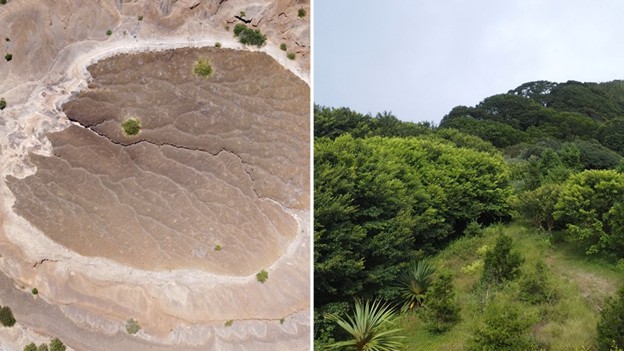
In the middle of nowhere, a small island emerges in the Atlantic Ocean. A unique territory that completely changed in the nineteenth century thanks to the concern of two British scientists: Charles Darwin and Joseph Dalton Hooker, researchers who stopped off at the British naval base and documented it on their expeditions to discover the world. With the idea of “harnessing the moisture of the clouds” they designed and organized a system to plant seeds from the botanical gardens that the British empire had in all its colonies; five decades of plantations that radically transformed the island from an utterly sunburned volcanic rock to a rainforest.
“Climate change is causing the loss en masse of the biodiversity of all the earth’s ecosystems and, increasingly, we have ecosystems that are prone to desertification”, explains Víctor Maull, who has just finished his PhD at Pompeu Fabra University where he is conducting research at the Complex Systems Laboratory (CSL) of the Institute of Evolutionary Biology (IBE, CSIC – Pompeu Fabra University) under the supervision of Ricard Solé, an ICREA researcher at UPF.
Ascension is one of the few places on Earth, if not the only one, that has undergone the reverse process in such a deliberate and documented way. It has gone from being a volcanic island inhabited by half a dozen species of dwarf ferns to a lush, highly humid rainforest, all thanks to a deliberate, anthropic process. “In the laboratory we are working to make minimal models that can explain changes to ecosystems. Normally, we model ecosystems that degrade, but with Ascension we have the opportunity to understand the reverse process and see if we can invert the collapse”, Maull explains.
A month on the island
To learn about the reality of Ascension, a team from the Complex Systems Laboratory made up of Maull himself and the postdoctoral researcher at the SynBio Lab of UPF, Nastassia Knödlseder, in collaboration with the Department of Conservation and the Government of the island, have spent a month on the island to study its transformation from a historical, ecological and microbiological point of view.
“Actually stepping foot on the island reveals the magnitude of the success of the planting process”, Maull states. “There, in just ten minutes, you can go from walking drenched through a rainforest to experiencing the most intense desert”, he adds. In addition to the experience, the team has consulted historical documents held by the national archives. “Nautical charts, logbooks and handwritten letters that explain the entire engineering process”. These documents will allow the CSL team to understand how the planting was orchestrated and the transformation that brought about a new biome on the island.

Víctor Maull and Nastassia Knödlseder at the PRBB facilities. Credit: UPF
To complete the study, they decided to also take into account the soil microbiome, a structure that the researchers consider the basis of any ecosystem. “The soil changes according to the available nutrients and allows us to identify rapid changes that modulate the ecosystem”, Nastassia Knödlseder outlines. Taking into account that the transition to green in Ascension has taken place very quickly, “the analysis of the microbiome of different regions of the island can be of great interest to complement the model”. These analyses will be carried out in collaboration with the BioFun Lab of the Institute of Natural Resources and Agrobiology of Seville.
Beyond discovery, modelling the change undergone is an opportunity to “see if other ecosystems that are deteriorating can reverse their tendency to collapse”, Maull asserts. “The model we are working with explains a local case, but everything we learn from Ascension we want to transfer to the world”, the young researcher concludes.