
From myth to science: dragons, roses and evolution
From myth to science: dragons, roses and evolution
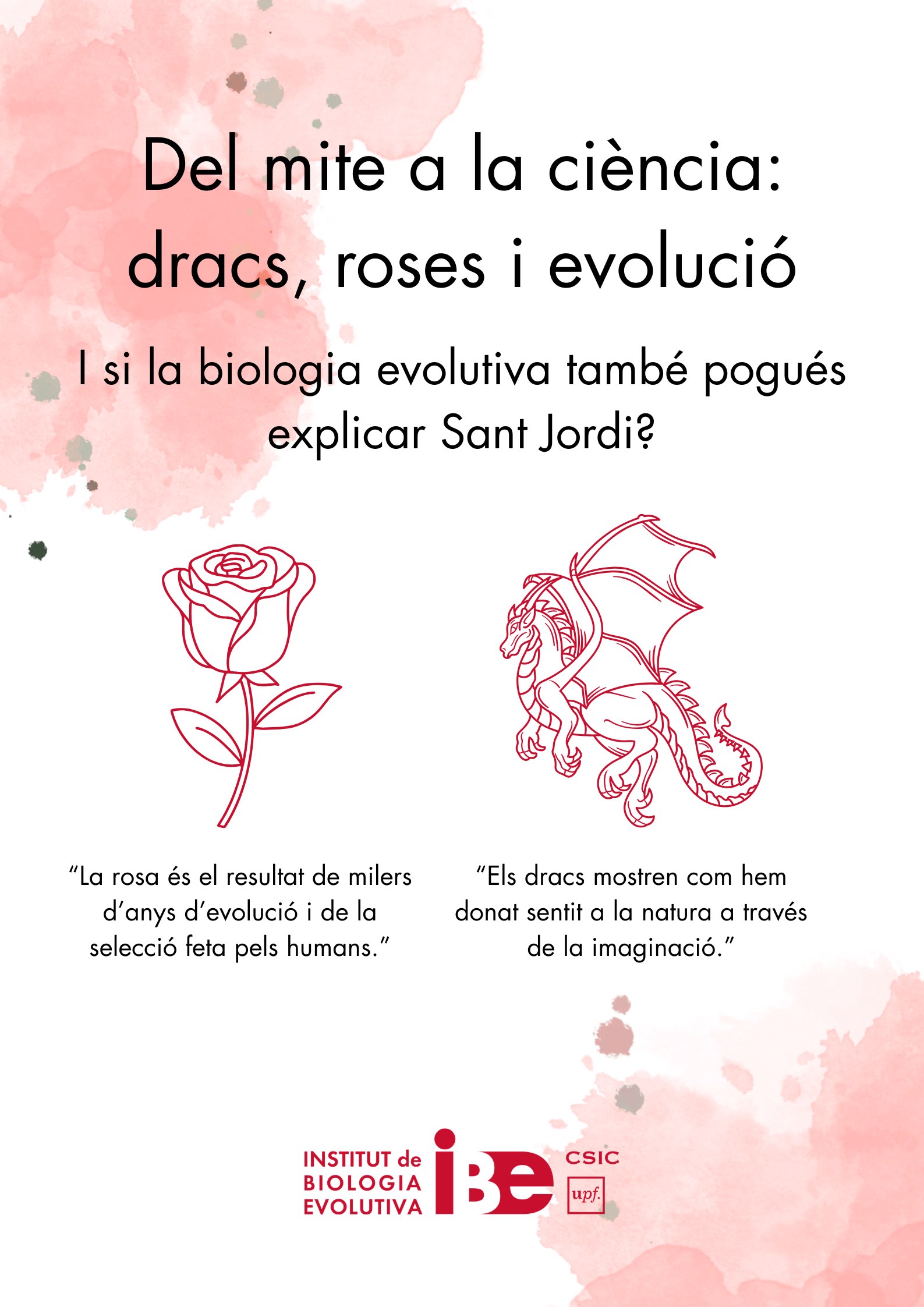
Sant Jordi’s roses: a product of evolution (and humans)
Roses are one of the most widely cultivated ornamental plants in the world and display a great diversity of shapes, colors, and fragrances. Today, there are hundreds of species and thousands of varieties, due to evolutionary processes that have acted over time.
On one hand, natural selection has favored traits that improve plant reproduction, such as attractive colors or scents that facilitate pollination. However, in the case of roses, there is also another key factor: artificial selection. Practiced by humans for centuries, it has enhanced aesthetic traits such as larger flowers, more petals, or more intense fragrances.
The rose we give on Sant Jordi is also the result of thousands of years of evolution and artificial selection.
One example is multi-petaled roses. Wild roses typically have five petals, but many ornamental varieties have dozens. This phenomenon is due to genetic mutations that transform stamens (the male reproductive organs) into petals, producing what are known as double flowers.


Illustration of the wild and ornamental rose. Credit: Berta Carreras
These variants have been selected by humans for their appearance, but this comes with consequences. Many ornamental roses produce less pollen and may be less useful for pollinators. This is a clear example of how artificial selection can modify traits that nature had optimized for another function.
Dragons: between nature and imagination
And what about dragons? Although they are mythical creatures and part of the collective imagination of many cultures, some of their features may be inspired by real animals.

Decorative dragon figure on a temple. Credit: Pexels
Referring to the article Changing the main character of the story: Let’s talk about dragons for St George Day, some examples include flying lizards of the genus Draco or large reptiles such as the Komodo dragon.
In other cases, unknown or hard-to-observe animals, such as Proteus anguinus (the cave salamander), were interpreted in the past as fantastic creatures. In the Middle Ages, they were even believed to be baby dragons.
It is also likely that some fossils were misinterpreted before the development of modern paleontology, contributing to the creation of these legends.
Dragons show us how humans have tried to understand nature through imagination, before the development of modern science.
In this context, the ideas of Charles Darwin marked a turning point in how we interpret nature. The theory of natural selection revolutionized our understanding of life on Earth. Darwin showed that species are not immutable, but change over time through small heritable variations that can enhance survival and reproduction. This framework is what allows us today to interpret both the diversity of rose forms and the real origins of animals that may once have inspired fantastic creatures like dragons.
Tradition and science
Roses and dragons, two iconic symbols of Sant Jordi, tell different but complementary stories.
In this context, roses symbolize life’s ability to diversify and adapt, while dragons remind us how human perception of nature can give rise to stories and myths.
Evolutionary biology helps us understand both the diversity of life and the stories we build around it.
Therefore, bringing science closer to society also means connecting it with culture. This Sant Jordi, it might be worth asking: how much evolution is hidden behind a rose?

Casa Batlló for Sant Jordi. Credit: Berta Carreras
References:
"Unravelling the complex origin and breeding history of modern roses". Nature Plants, 2024. https://www.nature.com/articles/s41477-024-01826-5