
Jurassic Park will remain fiction: resin does not preserve insect DNA better
Jurassic Park will remain fiction: resin does not preserve insect DNA better
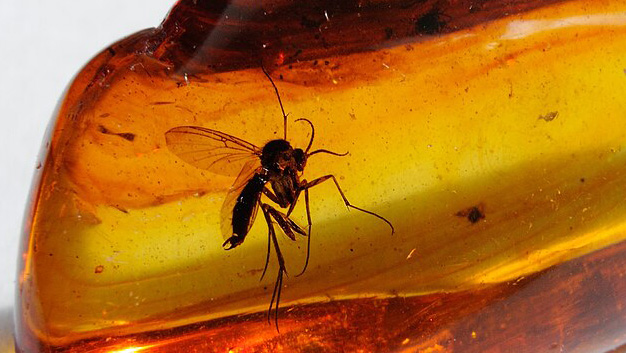
Can DNA remain protected from degradation for thousands or even millions of years when an organism becomes trapped in resin? This question has attracted considerable interest in modern palaeontology ever since Jurassic Park popularized the idea more than 30 years ago. Now, an international team led by the Botanical Institute of Barcelona (IBB, CSIC-CMCNB), with the participation of the Institute of Evolutionary Biology (IBE, CSIC-UPF) and the Geological and Mining Institute of Spain (IGME-CSIC), provides new experimental evidence on what happens when an insect becomes trapped in resin.
The study, published in Scientific Reports, shows that insects preserved in resin do not exhibit better DNA preservation than those kept outside this medium. “In fact, some of the samples analysed showed faster degradation of genetic material in specimens preserved in resin than in those kept outside it,” says David Peris, Ramón y Cajal researcher at the Botanical Institute of Barcelona and lead author of the study.
What Happens When an Insect Becomes Trapped in Resin?
To investigate this question, the team compared over a 30-day period the preservation of DNA, tissues and internal organs in two model insect species: the fruit fly (Drosophila melanogaster) and the red flour beetle (Tribolium castaneum). Researchers analysed specimens trapped in fresh pine resin and specimens preserved outside the resin and air-dried.
Molecular analyses showed that DNA degraded rapidly under both conditions and that entrapment in resin did not enhance its preservation.
“For a long time, it was assumed that resin isolated inclusions and promoted drying, favouring a form of mummification and the preservation of genetic material. However, our results suggest that resin may, in some cases, have the opposite effect by retaining moisture within organisms, which in turn favours rapid DNA degradation,” explain Xavier Franch and David Martín, CSIC researchers at the Institute of Evolutionary Biology.

Better Tissue Preservation, but Not DNA
By contrast, the study of internal tissues using synchrotron light tomography, a high-resolution imaging technique, showed that resin can indeed promote the preservation of certain tissues and internal organs. However, this effect was not consistent across all organisms, suggesting that species-specific anatomical characteristics play an important role.
“After 30 days, both flies and beetles preserved outside resin showed clearly desiccated tissues. In contrast, flies trapped in resin retained internal structures, such as muscles, largely intact,” explains Jesús Gómez-Zurita, CSIC research scientist at the IBB. “Beetles, on the other hand, are naturally well isolated from the environment by their chitinous exoskeletons. Although they retained the overall structure of their tissues, these appeared more degraded and showed a greater accumulation of gas bubbles, likely resulting from internal decomposition,” he adds.
Reopening the Debate on DNA in Amber
Over the past decades, several studies have claimed the recovery of DNA from organisms preserved in amber. However, many of these findings were later questioned because of potential contamination and reproducibility issues.
“The oldest DNA samples recovered from organisms trapped in resin are only a few hundred years old. Our study helps explain why. Most likely, DNA preserved in resin for millions of years will never be found,” concludes Peris.
Reference Article:
Peris, D., Cardoso, A., Mähler, B. et al. Resin does not safeguard insect DNA during early decay despite preservation of soft tissues. Scientific Reports 16, 24920 (2026). https://doi.org/10.1038/s41598-026-63724-4