
The arrival of the Suebi, Alans and Visigoths did not erase the deep genetic legacy of Roman Hispania
The arrival of the Suebi, Alans and Visigoths did not erase the deep genetic legacy of Roman Hispania
The arrival of the Suebi, Alans and Visigoths did not erase the deep genetic legacy of Roman Hispania
The Iberian Peninsula was one of Rome’s earliest major conquests. Its position between the Atlantic and the Mediterranean, together with its abundant natural resources, made Hispania a key territory for the Empire. Centuries later, the weakening of Roman power facilitated the arrival of the Alans, Vandals and Suebi in 409 CE.
After the fall of the Western Roman Empire, these and other Germanic groups established new kingdoms in various parts of Europe, including the Visigothic Kingdom, founded on the peninsula in 507. Although some were short-lived, these emerging states helped shape medieval political identities and, in the long term, the map of Europe’s future states.
It was, however, still an open question as to whether the profound political and cultural influence of these migrations was accompanied by a demographic transformation of comparable magnitude.
Now, an international study led by the Institute of Evolutionary Biology (IBE), a joint centre of the Spanish National Research Council (CSIC) and Pompeu Fabra University (UPF), the Natural Sciences Museum of Barcelona, Harvard University and the University of the Basque Country (EHU) has concluded that the Roman conquest of the Iberian Peninsula did indeed produce a large-scale demographic change. In contrast, the Suebi, Vandal, Alan and Visigoth migrations in Late Antiquity had a more limited impact on the genetic makeup of Hispania.
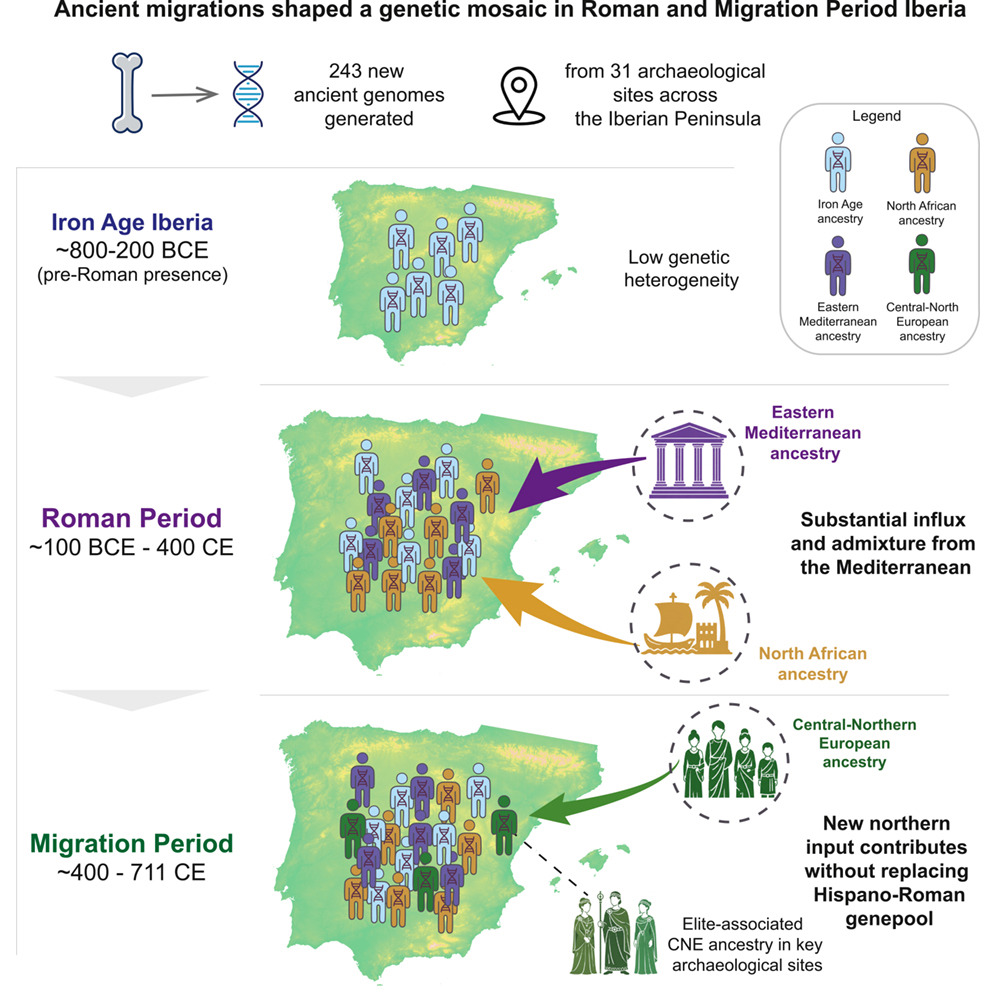
The study, published in Cell, analysed 243 ancient genomes from 31 archaeological sites, together with previously available genomic data. By combining this genetic and archaeological evidence, the researchers have been able to reconstruct the population history of the peninsula between the 1st and 8th centuries CE.
Rome turned Iberia into a Mediterranean genetic mosaic
The study, the first systematic, large-scale archaeogenomic analysis of this period, shows that the Iberian population changed profoundly as Roman rule became established. In contrast to the relative genetic homogeneity of the Iron Age, individuals from the 1st to the 4th centuries CE display much greater ancestry diversity.
Roman rule encouraged the arrival of people with eastern Mediterranean and North African ancestry, creating a heterogeneous society connected to human networks across the Mediterranean.
“Romanisation was not only a political, linguistic and cultural transformation. Our data shows that it was also a major demographic transformation, connecting local populations with human movements originating in different parts of the Mediterranean”, explains Carles Lalueza-Fox, current director of the Natural Sciences Museum of Barcelona, co-senior author of the study and principal investigator at the IBE (CSIC-UPF).
The new Germanic elites left a mark, but did not radically alter the genetics of the local population
From the 5th century onwards, the study has identified individuals with Central and Northern European ancestry, particularly in archaeological contexts associated with the new political groups. However, most communities retained the diverse profile of the Hispano-Roman population.
“What surprised us most was the contrast between the two processes. Rome created an extraordinarily diverse society due to population movements across the Mediterranean. Later migrations introduced new ancestries, but their demographic impact was much smaller”, says Pablo Carrión, first author of the study, who completed his doctorate at the IBE (CSIC-UPF) and is now a postdoctoral researcher at the Max Planck Institute for Evolutionary Anthropology in Leipzig.
The genetic contribution of these groups ranges from 12% to 22%, depending on the region and social context. Admixture with local populations was gradual and did not radically alter the genetic landscape, unlike in Britain or the Balkans, where post-Roman migrations had a greater demographic impact.
“The genetic history of the Iberian Peninsula differs from that of other parts of post-Roman Europe. We find migration and new ancestries, but not population replacement or large-scale demographic impact”, says David Reich, principal investigator at Harvard University and co-senior author of the study.
Two family stories reveal migrations, alliances and struggles for power
Behind these large population movements there are, however, also individual and family stories that genomic analysis can help reconstruct. The team identified two siblings buried around 725 kilometres apart, in present-day Mérida, ancient Augusta Emerita, and at the Roman posting station of Ildum in Castellón, beside the Via Augusta. Both had entirely Central European ancestry and were probably first-generation migrants.

Genetic analysis identified two siblings buried at the archaeological sites of Castelló and Mérida, approximately 725 kilometres apart when travelling along the Roman road network. The image also shows the Germanic-style gold pins recovered from the two sites. Credit: Cell, Carrión et al.
Their kinship and the archaeological context of their richly furnished burials point to a possible route taken by the Suebian migration. “We are not simply observing changes in genetic frequencies; we are identifying families who moved across a peninsula that was still connected by the infrastructure of the Roman Empire”, explains Iñigo Olalde, co-author of the study and Ikerbasque Research Professor at the EHU.
Other remains, those of the so-called “Suebian princesses”, reveal another side of this process. Although their rich grave goods led them to be regarded as members of an elite that arrived from beyond the imperial frontiers, one of them had local ancestry. The finding points to marriage alliances between Suebian elites and Hispano-Roman families. The deaths of several of these women within the same period may have been linked to a succession dispute in an elective monarchy.
“These women show how genetics can change our interpretation of past elites: an identity associated with migrant groups, whether Visigothic or Suebian, did not necessarily imply foreign origin, as this could also be acquired through family, political and cultural alliances”, adds Pablo Carrión.

Illustrations suggesting a possible reconstruction of the Suebian princesses. Credit: Joaquín Suárez.
A genetic history that remains incomplete
Iberian populations in Late Antiquity were genetically more heterogeneous than those of the present day. This indicates that the gene pool changed once again during the mediaeval and post-mediaeval periods, shaped by Visigothic rule, the Islamic conquests, internal population movements, and the expansion of the Christian kingdoms.
“Future studies of mediaeval and post-mediaeval genomes are essential to connect the peninsula’s ancient inhabitants with its present-day populations, with implications for the historical, cultural and even political fields”, notes Lalueza-Fox. The team also emphasises the need to expand sampling, particularly in northern Iberia and North Africa.
The paper shows that major political changes did not necessarily have equivalent demographic consequences. Rome profoundly transformed the composition of Iberian society; the elites of Late Antiquity, in contrast, exerted a lasting political and cultural influence without replacing the population.
Reference article: Pablo Carrión, Iñigo Olalde, …, Carles Lalueza-Fox, David Reich. Contrasting demographic impacts of Roman colonization and early medieval migrations in the Iberian Peninsula. Cell (2026). DOI: https://doi.org/10.1016/j.cell.2026.09.052