
New clues to understanding insect metamorphosis
New clues to understanding insect metamorphosis
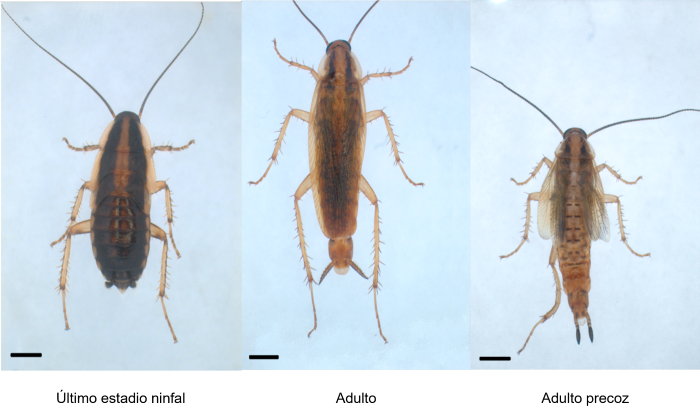
Understanding how animal growth and metamorphosis are regulated has applications in fields as diverse as medicine, pest control, and evolutionary biology. However, the mechanisms governing insect development are complex, and their genetic map remains incomplete today.
A study by the Institute of Evolutionary Biology (IBE), a joint center of the Spanish National Research Council (CSIC) and Pompeu Fabra University (UPF), confirms the role of Chinmo in inhibiting metamorphosis in the German cockroach (Blattella germanica). The research reveals the mechanisms of action of the genes Chinmo and Abrupt in halting its growth. For the first time, the study establishes the evolutionary trajectory of these growth-regulating genes in insects, with implications for evolutionary biology and pest control.
New key mechanisms revealed in German cockroach metamorphosis
Insect growth and metamorphosis respond to a complex genetic puzzle that research has been deciphering for decades. In previous studies, the IBE team established an apparently simple pathway: the juvenile hormone (JH) and the gene Kr-h1 maintain the juvenile stage by inhibiting the gene E93, which promotes metamorphosis. This pathway is known as the MEKRE93 pathway, which regulates metamorphosis in insects.
Subsequent studies incorporated Chinmo and Abrupt, two genes involved in maintaining the juvenile stage in insects. Until now, however, their precise mechanisms of action were unknown.
The research published in PLOS Genetics reveals that Chinmo and Abrupt act synergistically to maintain the juvenile stage in insects, although they do not interact directly with each other. Through gene inactivation experiments, the IBE team concluded that Chinmo directly inhibits the factor E93, preventing the onset of metamorphosis.
Abrupt, in contrast, acts indirectly: it activates the expression of the gene Kr-h1, which in turn represses E93. These results shed light on the genetic regulatory map that governs the transition from the juvenile to the adult stage in insects.

Evolution of metamorphosis regulation from hemimetabolous insects (top) to holometabolous insects (bottom): genes involved in maintaining the juvenile stage are shown in orange, and metamorphosis genes in green. The gene Chinmo expands its inhibitory effect from E93 to BR-C in holometabolous insects. The gene BR-C also expands its role in complete metamorphosis. Credit: Xavier Bellés.
“Both genes maintain the juvenile stage of insects, but they do so in different ways. We observed that Kr-h1 acts as a ‘switch’ for metamorphosis, while Chinmo adjusts its speed and timing,” comments Xavier Bellés, principal investigator at IBE who led the research.
New perspectives on insect evolution
Complete metamorphosis in holometabolous insects—such as butterflies, flies, and beetles—evolved from ancestors with simple metamorphosis (hemimetabolous insects), such as the German cockroach.
“Chinmo and Abrupt were identified in studies of insects with complete metamorphosis, where they inhibit this process. Revealing their mechanism of action in the German cockroach could shed light on the evolution of metamorphosis,” Bellés explains.
The study shows that the gene Chinmo has evolved in its regulatory functions. In insects with complete metamorphosis, Chinmo prevents the adult stage by inhibiting E93, and also prevents the formation of the pupa—a key step in the transformation—by inhibiting the gene Broad-Complex (BR-C). In simple metamorphosis, however, Chinmo only acts on E93.
“In the transition from hemimetabolous to holometabolous insects, Chinmo acquired the ability to inhibit BR-C, thereby preventing pupal formation—a new and exclusive step in complete metamorphosis,” Bellés explains. He adds: “The new data on the regulatory role of these genes show that metamorphosis, and its evolutionary history, is more intricate and complex than current models suggest.”
Expanding knowledge about cockroaches
The German cockroach is considered a particularly relevant pest due to its adaptation to urban environments and its high mobility, which facilitate the transmission of bacteria and other pathogens, as well as allergic reactions.
In this context, several teams at IBE are working to identify genes involved in the development of Blattella germanica. Understanding these genes is key to studying its biology and has potential applications in designing more precise future pest-control strategies.
“Understanding the genetics of B. germanica is essential for developing control techniques that do not affect other animals in urban environments and that respect the environment. With this study we are closer to completing its gene-interaction map and understanding the keys to its development,” says Bellés, who participated in the 2019 IBE project “Pon freno a las cucarachas” (“Stop the Cockroaches”). The project developed the molecular tool DIPA-CRISPR, a new technique that enables genome editing in cockroaches. The potential applications of this tool expand as knowledge of the cockroach genetic map grows.
Referenced article:
Escudero J, Gonzalvo J, Piulachs MD, Bellés X. 2025. Chinmo function in cockroaches provides new insights into the regulation and evolution of insect metamorphosis. PLOS Genetics. DOI: 10.1371/journal.pgen.1011993.